Backyard Ultra Rules
Backyard Ultra Rules: The Complete Official Guide
Unlike a traditional ultramarathon where you race against the clock over a set distance, or a timed event where you cover as many miles as possible before a buzzer sounds, the Backyard Ultra is an open-ended elimination race. Devised by Lazarus Lake (Gary Cantrell) and named after his flagship Tennessee event, Big Dog’s Backyard Ultra, the format strips endurance running down to a single question: who can keep going one hour longer than everyone else?
Whether you are toeing the line at one of the many UK Backyard Ultra events or chasing a silver ticket to represent your country on the world stage, the rules governing the sport are famously concise, and notoriously unforgiving. Below is a complete breakdown of the official Big’s Backyard Ultra rules and how they are enforced on race day.
The Backyard Ultra Concept and Key Terminology
Before diving into the regulations, it helps to understand the language of the sport:
- Yard: A single loop of the course, measuring exactly 100/24 miles (4.16666... miles, or 6.7056km). Every 24 yards equates to 100 miles (100.008 miles to be exact).
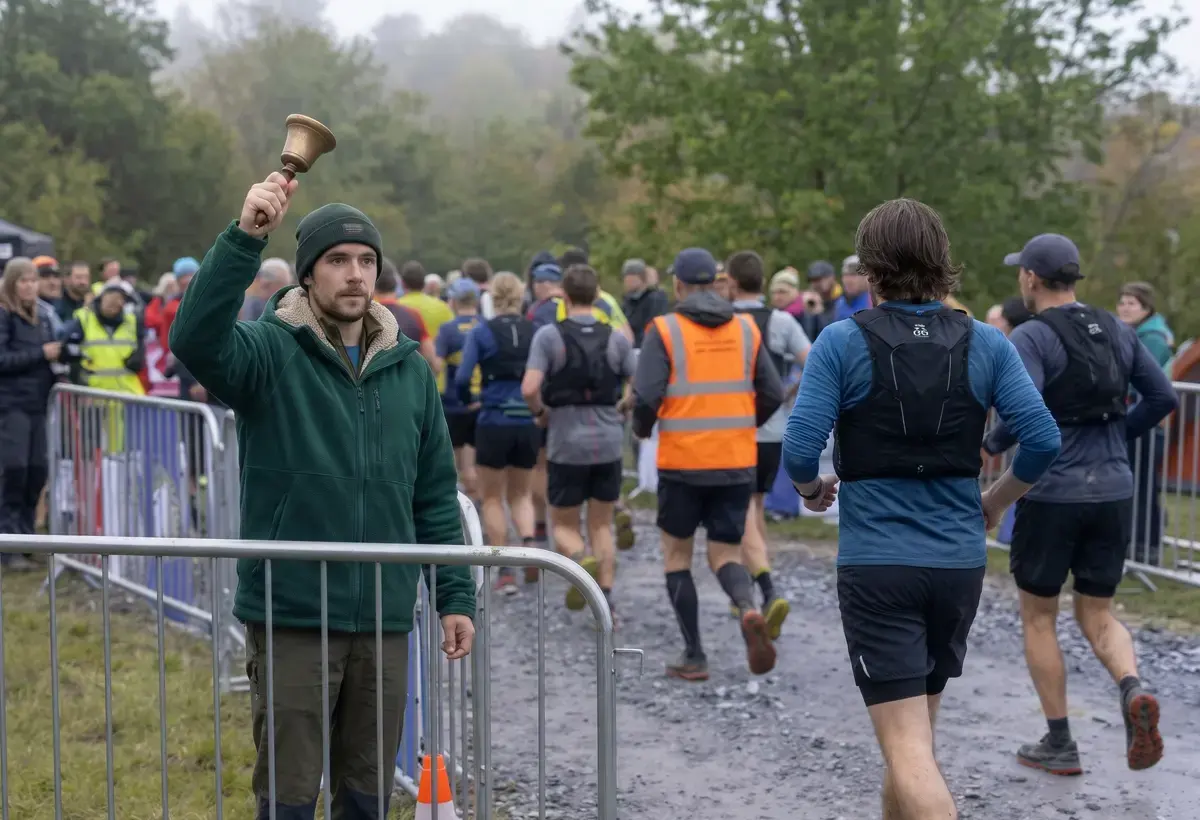
- Bell: The signal sounded on the hour, every hour, marking the start of a new yard.
- Corral: The marked starting pen at the race hub where runners must gather before each bell.
- Last One Standing: The sole winner of the race, the only athlete to complete one final yard that no other competitor finishes.
- Assist: The runner (or runners) who complete the second-highest number of yards, always exactly one yard fewer than the winner.
- DNF (Did Not Finish): The official classification given to every participant except the single winner, regardless of whether they cover 12 yards or 100 yards.
The Official Backyard Ultra Rules
1. The Course
- Layout: The route may be a single loop, an out-and-back, or multiple smaller loops connected together. If a figure-of-eight or multi-loop route passes back through the race camp mid-yard, organisers must provide a taped, marshalled running lane so runners cannot receive assistance while passing through.
- Distance: Every yard must measure at least 100/24 miles (4.16666... miles, or 6.7056km). A venue may make its loop slightly longer if local geography requires it, but it can never be shorter. Any race with a short course is invalid, and no records set on it will stand.
- Day and Night Loops: Organisers are permitted to switch from a technical trail loop during daylight hours to a safer, more runnable road or hard-packed track loop after dark. Both loops must measure the full 6.7056km minimum, and every active runner experiences them in identical proportion.
2. The Starting Corral
- Size and Markings: The starting corral is marked with tape, paint, or cones and measured to comfortably hold the entire starting field. Its dimensions remain fixed from the first yard to the last; it never shrinks as the field thins out.
- Entering Under Your Own Power: To start the next yard, you must have crossed the finish line to complete the previous loop and be standing completely inside the corral under your own power when the bell rings. Having one foot over the line at the bell counts as out.
- Clearing the Corral: Non-competitors (including crew and spectators) are prohibited from being inside the corral once the three-whistle warning blows three minutes before the start.
3. Starts and the Hourly Clock
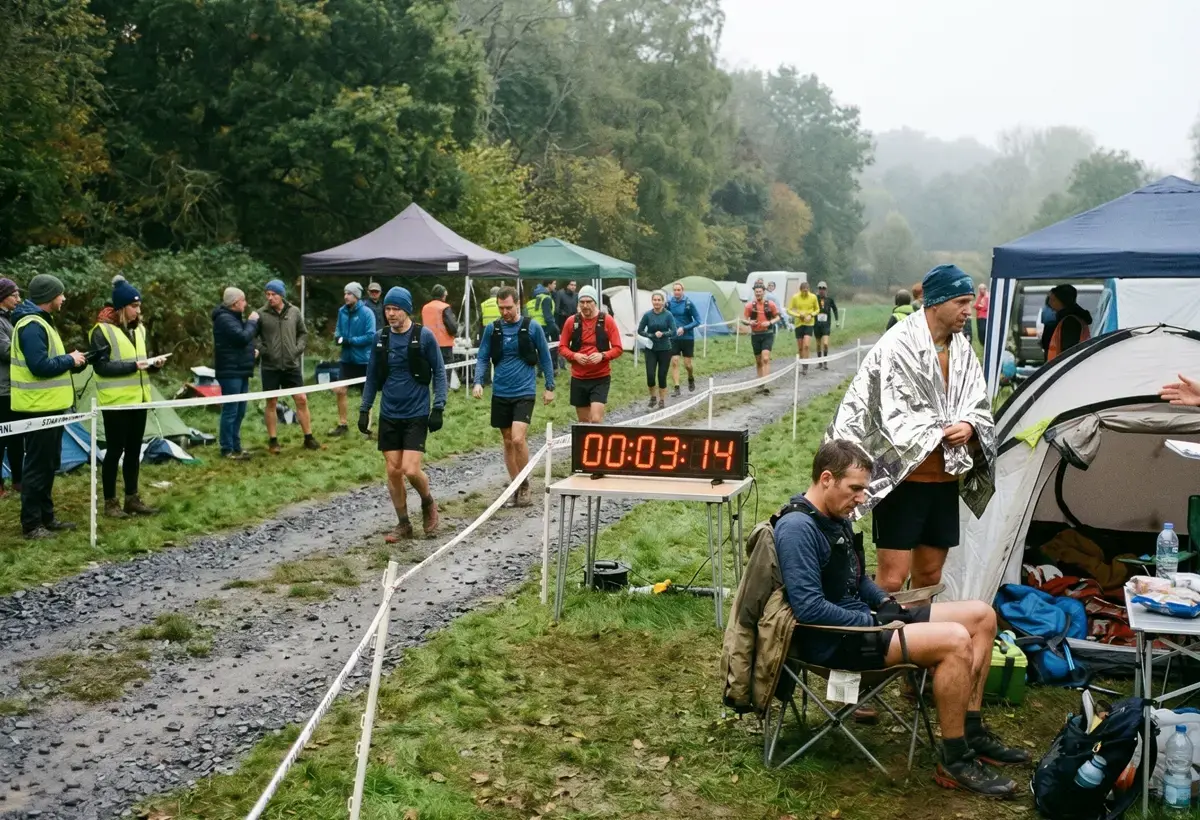
- One-Hour Intervals: Each new yard begins precisely one hour after the start of the previous yard, never one hour after you finish. If a yard begins at 09:00 and you finish in 51 minutes, you have 9 minutes to eat, rest, and return to the corral before the 10:00 bell.
- Whistle Warnings: Race officials must give audible warnings at three minutes (three whistles), two minutes (two whistles), and one minute (one whistle) prior to the bell. From the three-minute mark until the bell, these whistles must be the loudest sound in camp.
- No Late Starts: Every competitor must start together at the bell. You cannot deliberately hang back in the corral after the bell rings to avoid congestion or tie a shoelace; if you need to adjust your gear, you must cross the start line first.
4. Completing Each Yard
- Strict One-Hour Limit: Every yard, including the solo final yard, must be completed in less than one hour (59 minutes and 59 seconds or faster). Crossing the finish line at exactly 60:00 as the bell rings means the lap does not count and your race is over. Unused time from faster laps never carries over.
- Staying on Course: Once the bell rings, you cannot leave the marked route until you cross the finish line. You cannot duck back to your tent for forgotten kit or take a shortcut.
- Toilet Breaks: The sole exception to leaving the course is a restroom stop. Whether using a course-side portable toilet or a discreet spot off the trail (check local venue rules first, as some landowners strictly ban wild wees where toilets are provided), you must rejoin the course at the exact point you left it, gaining zero distance. Using course-side bins to discard gel wrappers is permitted, provided you do not stash kit for later.
5. No Pacing or Accompaniment
- Solo Effort on the Loop: No non-competitors, including crew, friends, family, pacers, or previously eliminated runners, may travel alongside an active runner on foot, by bike, or via any other conveyance. Even jogging the final 200 metres into the corral with a partner is grounds for disqualification.
- Officials and Media: Marshals, medics, race directors, and accredited photographers or film crews are allowed on the route, provided they remain stationary at fixed posts while runners pass. The only moving exception is an official, clearly lit safety sweep or tail bike, which must stay at least 100 metres behind the final runner at all times without offering light, shelter, pacing, or information.
- Members of the Public: On open public footpaths or roads, ordinary passers-by are not an issue unless they begin running with you. If an unbidden member of the public tries to jog alongside you, you must tell them you cannot run together and report the incident to a marshal immediately so it is logged.
6. No Personal Aid During a Yard
- Self-Sufficiency on the Loop: Once a yard starts, you cannot receive any physical help or be handed any item by a non-competitor. Everything you eat, drink, or wear on the loop must be carried with you from the start line. Between yards in camp, crew support is completely unrestricted.
- Shared Aid Stations: Events may provide a common, self-service water or electrolyte station out on the course (usually in hot weather), open to every runner on equal terms. However, you must pour and fill your own bottles; a volunteer taking, filling, or handing you a bottle, or lining up pre-filled cups, counts as illegal assistance.
- Sharing Between Active Runners: Active competitors are allowed to hand food, drink, or spare kit to one another out on the loop, provided those items were carried from the start line by one of the runners.
- High-Fives and Spectators: While spectators can shout encouragement, call out time splits, or share tactical updates from fixed spots beside the trail, runners are strongly advised to avoid high-fives or physical contact on the loop so there is never any suspicion that an item was passed. Save the hugs for camp.
- Medical Checks: Medics can observe and speak to you from the side of the course without affecting your race, but if they lay hands on you or administer treatment out on the loop, your race ends at your last completed yard.
7. Equipment and Prohibited Aids
- No Artificial Aids: You must cover the distance entirely under your own power. Trekking poles, walking poles, and any powered or propulsive devices are strictly banned, regardless of how steep or muddy the terrain is.
- Permitted Gear: Standard trail running equipment, including head torches, hydration packs, GPS watches, passive knee supports or braces, and wheelchairs for wheelchair athletes, is allowed. Visually impaired runners may compete with a guide, provided the guide follows all race rules and started from Yard 1 (fresh guides cannot swap in mid-race).
- Phones and Headphones: Mobile phones and headphones are permitted under the overarching Backyard Ultra rules (useful for safety, music, or checking continuous glucose monitors), though individual race directors have the authority to restrict or ban them in their specific event briefings.
- Anti-Doping: The sport adheres to WADA guidelines regarding prohibited substances.
8. Passing Etiquette
- Slower Runners Must Yield: If a faster runner catches you on narrow single-track, you must yield and allow them to pass at the earliest safe opportunity. This is particularly crucial in the later stages of a race when a competitor is sprinting against the 60-minute cutoff.
9. Declaring the Winner and Results
- How the Race Ends: The race is open-ended with no distance cap or finish line. It continues until one runner completes a single yard that no other competitor finishes within the hour. Once that winning yard is completed, the race ends immediately, the winner is not permitted to run extra victory laps.
- The Final Two: When only two runners remain, both must complete the current yard and enter the corral at the bell to start the next. If one drops out or misses the cutoff, the remaining runner must still go out and complete one final solo yard inside the 60-minute limit to claim the win.
- No Winner Scenario: If the final lone runner fails to complete their winning solo yard within the hour (or drops out), there is no winner. Every participant is recorded as a DNF, and all runners tied for the highest number of completed yards share the Assist.
- Timing: Recording individual lap times is optional for race organisers, as official rankings are determined strictly by total completed yards.
10. Weather Stoppages and Disqualifications
- No Pausing the Clock: If severe weather such as lightning forces a race director to halt proceedings for safety, the clock cannot be paused and resumed later. The event must either end immediately, with official results standing at the last completed yard, or restart completely from Yard 1 once the storm passes.
- Partial Credit on Disqualification: If an individual runner commits an isolated rule breach (such as receiving aid on Yard 43), they are disqualified from continuing, but their previously completed clean yards stand (recording a DNF at 42 yards). However, if a breach is systemic across multiple loops, or if an event fails at an organisational level, such as having a short course or allowing volunteers to refill bottles on the loop, the entire run or event can be voided.
11. One Race at a Time & Fixed-Time Backyards
- Simultaneous Starts Only: Only one event may operate on the loop at a time. No secondary race can start later on the same course, and no new runners can join mid-event.
- Fixed-Time Backyards: Organisers may host a capped version, known as a Fixed-Time Backyard (for example, a 12-hour or 24-hour event), either standalone or alongside a true open-ended Backyard Ultra. All standard rules apply, and if run alongside an open race, both fields must start together at the very first bell. In a fixed-time event, no overall winner is crowned; anyone who completes every yard up to the time cap is an official finisher, while anyone who falls short is a DNF.
Ready to Test Yourself on the Hourly Bell?
Now that you know the rules inside out, browse our full directory of upcoming Backyard Ultras in the UK to find your next last-one-standing challenge.